
Pricing
What Does a Dumpster Actually Cost in Maricopa?
City refuse service here is mandatory and you cannot opt out of it. Knowing what it does and does not cover tells you when you actually need a container.
The honest answer up front
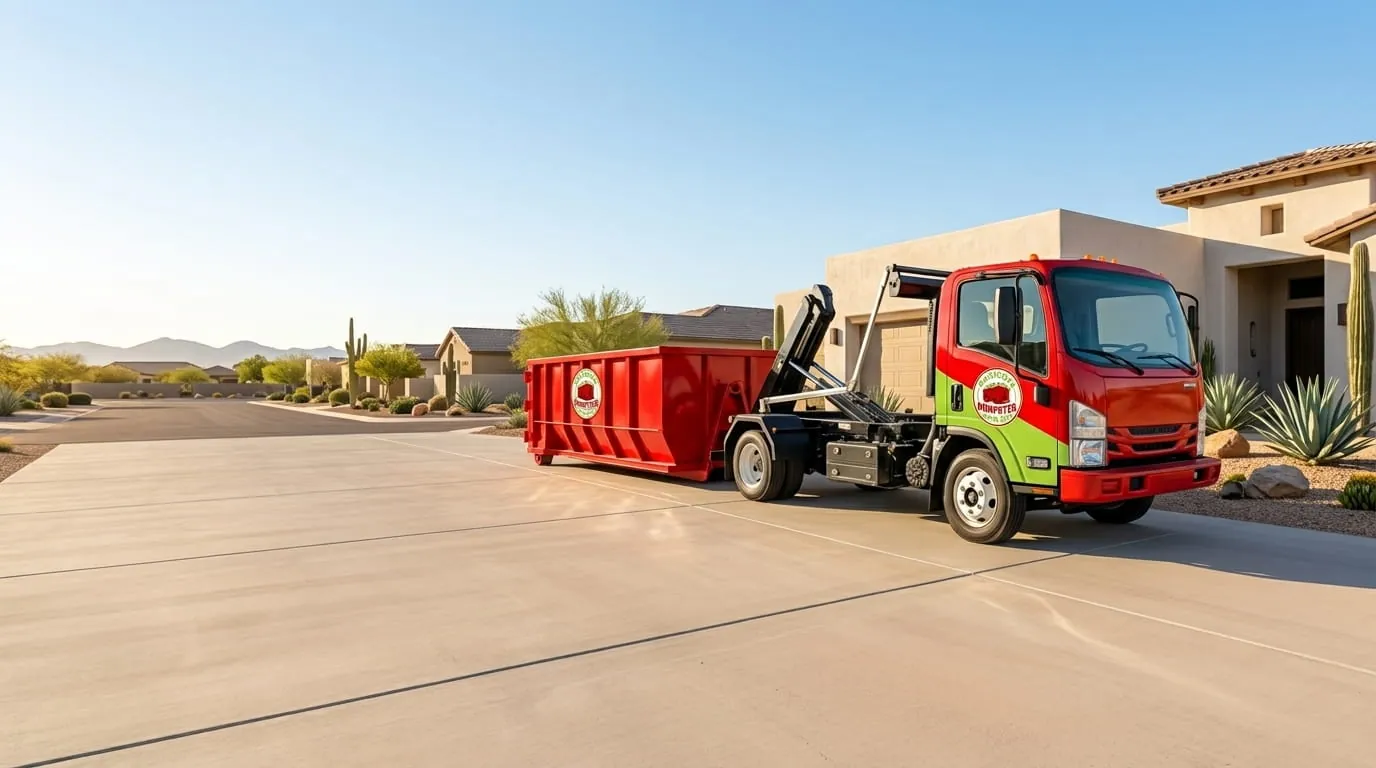
Most dumpster rentals around Maricopa land between roughly $375 and $650. A 10 yard for a bathroom renovation sits near the bottom. A 30 yard on a job site sits near the top. Roof tile, concrete, block and soil push it higher because they are charged by weight.
That is a wide range, and anyone quoting a single number without asking what you are throwing away is guessing.
What a flat rate should include
- Delivery to your address
- The rental period — the days it sits on site
- Collection when you are done
- Disposal at a licensed facility
- An included weight allowance, stated in tons before you book
If a quote does not cover all five clearly, it is not a flat rate. The usual omission is the weight allowance, and it is not an accident.
The five things that move the price
1. Container size
The obvious one, though much of the cost is the truck movement rather than the steel box.
2. What the material weighs
Disposal is charged by the ton. A 20 yard of cabinetry and drywall might weigh under two tons; the same container of roof tile could weigh seven. This is the single biggest variable in Maricopa.
3. The material stream
Clean segregated material disposes more cheaply than mixed waste. Clean concrete, block and tile have their own route, and scrap metal has positive value — which matters on the acreage properties, where there is always more of it than expected.
4. How long you keep it
The standard period is built into the flat rate; extensions run at a modest daily rate. Ask what it is — and if your HOA caps how long a container may sit in view, tell us and we will build the booking around that instead.
5. Distance
A community five minutes up the parkway is quicker to serve than an acreage property out past Thunderbird Farms or a run down to Arizona City. We build that into the quoted number rather than adding it afterwards.
City service is mandatory — and limited
Worth understanding properly, because it is unusual and because it defines what a container is actually for.
So the question is never "should I use city service or rent a container". You have city service either way. The question is what to do with everything it was never designed to take.
A related provision catches people in HOA communities: where the city's permittee provides service exclusively, residents whose HOA has contracted a private hauler must switch to the city's approved company when that contract ends. The city can even request verification of a private contract and its expiry date. If you are on an HOA board here, that is worth knowing before renewal season.
What city collection does not handle is renovation debris, demolition material, roof tile, concrete, soil, a whole-garage clear-out or a tree that came down in a storm. That is the gap, and it is the entire reason this business exists.
Where the extra fees come from
| Charge | What it is | How to avoid it |
|---|---|---|
| Weight overage | Per ton above the included allowance | Size for weight; separate tile, concrete and soil |
| Extension days | Keeping it past the agreed period | Book a realistic period; check your HOA limit |
| Dry run | Driver arrives and cannot place | Arrange gate access; confirm the placement spot |
| Overfill | Loaded above the rail; cannot be hauled legally | Stop at the fill line and call for a swap |
| Prohibited items | Separation and special handling | Ask before loading anything questionable |
The dry run matters more here than in most markets for one specific reason: gated communities. A loaded roll-off cannot sit at a gatehouse while somebody is found. Arrange access when you book.
Broker pricing, and the two-Maricopa problem
A broker owns no trucks and no containers. They run a website that ranks, take your booking and your card, then sell the job to a local hauler for less than you paid. The gap is their margin.
There is a local test that works unusually well here.
National booking desks conflate the two constantly, because the name collision is genuinely confusing. If somebody quotes you Maricopa County rules, or cannot say which county your house is in, they are not local.
A second test: ask what the dust permit threshold is. Anyone working here knows it is a tenth of an acre.
The heat is a real cost factor
Not something most guides mention, but it affects how a job actually runs.
Through the hottest months, work happens early. Crews start at first light and stop by early afternoon, which compresses the working day and stretches a project across more days than the same job would take in March. If your rental period is priced around a week, a summer job can genuinely need longer.
Two practical consequences worth planning for:
- Book a slightly longer window in summer rather than paying extension days at the end.
- Ask for an early delivery. Getting the container on site at seven in the morning gives you a usable working day; getting it at two in the afternoon in July does not.
Ways to genuinely reduce the cost
- Separate the heavy material. Tile, concrete, block and soil in their own small container is the biggest saving available to most people here.
- Pull the scrap metal. Positive value, and acreage properties produce a lot.
- Cut green waste down. A mature mesquite loaded whole takes three or four times the space of the same tree cut into lengths.
- Break material down. Dismantled furniture and cut timber take a fraction of the space.
- Arrange gate access up front — it prevents the one genuinely avoidable fee on this list.
- Book storm work early, because after a monsoon cell everyone calls the same afternoon.
- Tell us about the HOA limit. Scheduling collection to fit it costs nothing and avoids a fine that costs more than the rental.
Need a container in Maricopa?
Call and describe the job. Three minutes on the phone gets you a size recommendation, a flat rate and a delivery window — and we will tell you if a smaller, cheaper container is the right answer.
Call (520) 217-7573